What is a Marketing Philosophy?
Marketing philosophy is a fundamental strategy that directs a company’s actions toward customers and goals. It’s a mindset guiding how a company engages with customers and achieves its objectives.
This approach emphasizes different factors, such as product quality, aggressive selling, customer needs understanding, or a comprehensive perspective considering all elements.
Evolution of Marketing Philosophies
Marketing philosophies are also called marketing management philosophies or marketing concepts. Since the civilization of humans, the concepts of marketing have started to evolve.
Since then, six concepts of marketing have evolved; they are pictured below.
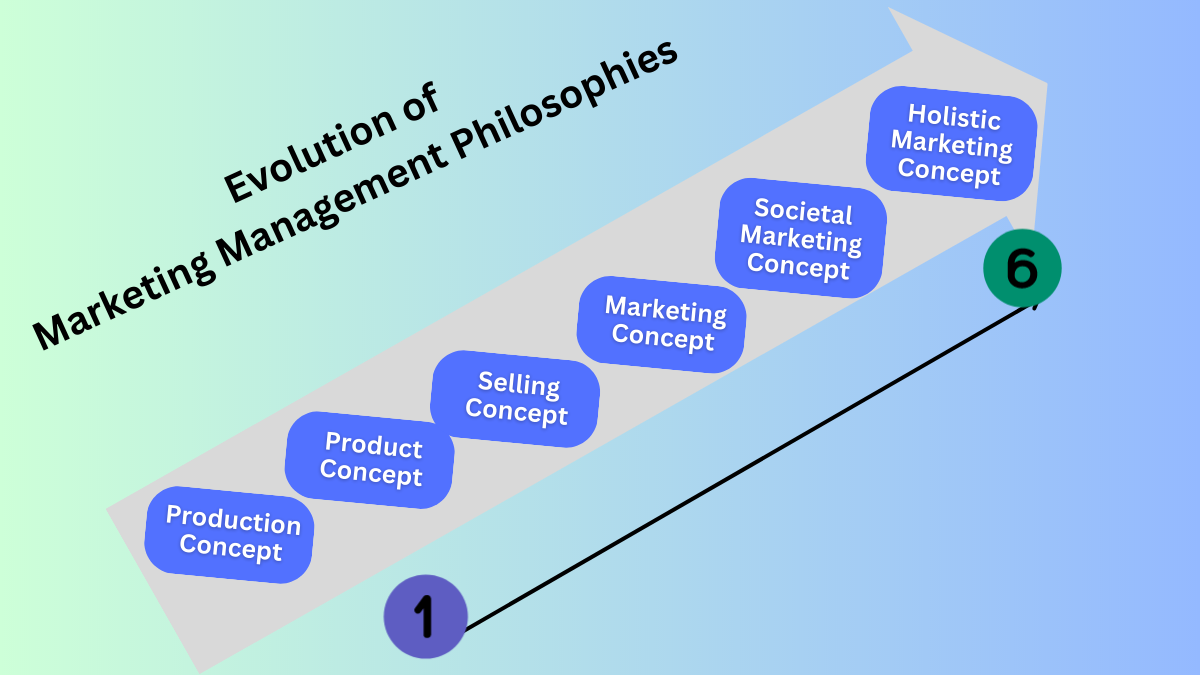
From them, the production concept of marketing is the first or earliest marketing concept, whereas, the holistic marketing concept is the latest addition to marketing philosophies.
The 6 Marketing Concepts with Examples: Defining
So far we understand, the six marketing concepts have evolved so far, let’s understand each marketing philosophy in detail with examples.
Production Concept
The production concept of marketing centers on offering products that are easily accessible and cost-effective. Businesses adopting this philosophy aim to maximize profits by producing goods in large quantities, benefiting from economies of scale.
This approach originated during the Industrial Revolution to meet high demands. By enhancing production efficiency, companies can provide goods at lower prices, attracting consumers.
Product Concept
The product concept in marketing focuses on crafting products that boast top-tier quality, performance, and features. This approach compels businesses to cater effectively to customer desires, emphasizing excellence as the key driver.
Rooted in the 1930s and lasting through modern strategies, the product concept emerged alongside the production concept, shifting focus to creating superior-quality goods.
Selling Concept
The selling concept of marketing lies in the notion that customers won’t naturally buy a company’s products, necessitating strong promotional and sales efforts. Emerging post-World War II, it prevailed until the mid-20th century.
This approach heavily relies on persuading potential buyers to convert latent needs into purchases through assertive techniques.
Marketing Concept
The marketing concept is a strategic philosophy that prioritizes creating products tailored to meet the needs of customers. It emerged around the 1950s, signaling a shift from production-centered approaches.
This concept revolves around understanding customer desires deeply and crafting offerings that cater to them effectively.
Characterized by a customer-centric approach, the marketing concept involves thorough market research, customer satisfaction as a priority, long-term perspective, and integrated marketing efforts.
Societal Marketing Concept
The Societal Marketing Concept, introduced by Philip Kotler in the 1970s, advocates aligning marketing decisions with consumer desires, company needs, and long-term societal welfare.
It goes beyond profit-driven approaches, emphasizing sustainable practices and ethical considerations.
This concept balances customer satisfaction, business goals, and societal well-being, promoting harmony between these factors. It prioritizes ethical actions, long-term vision, and positive impacts on society.
Holistic Marketing Concept
The Holistic Marketing Concept considers a business as an interconnected entity, integrating departments like sales, operations, and customer service to work collaboratively toward a shared goal.
Emerging in the early 2000s, it emphasizes synergy and cohesion across the organization for enhanced customer experiences and brand strength.
Related: The 4 Principles of Holistic Marketing Concept
Which Marketing Philosophy is Best and Why?
Among the six marketing concepts – Production, Product, Selling, Marketing, Societal, and Holistic – the best one depends on the business’s goals and the current world.
The production focuses on making lots but might not consider customer needs. The product emphasizes quality, but if customers don’t want it, it won’t succeed. Selling pushes products, but it might not care about what customers want.
Marketing understands customers and makes things they want. Societal cares about society and ethics, which can improve the brand. Holistic sees the business as a team, working together for success.
The “best” concept considers customers, society, and the company’s goals, like marketing, societal, or holistic. Today, as people care more about ethics and relationships, the Societal and Holistic concepts shine by considering everyone – customers, the community, and the business.
So, the best philosophy is the one that blends marketing understanding, ethical responsibility, and unified teamwork.
Read Next: 5 Core Concepts in Marketing

Arti Kushmi holds a BBA (Bachelor in Business Administration) degree and shares her business and marketing knowledge through this website. While not writing she will be reading and enjoying the moment.